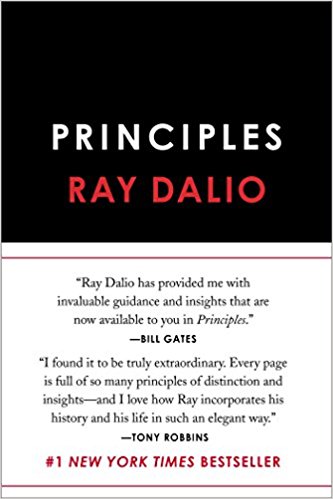
Principles is one of the hottest new books out in the business community today. Written by the founder of the world’s largest hedge fund, Ray Dalio shares his insights into building a successful career. He attributes his success to establishing personal and business values he learned from previous failures and applying those values, or principles, to each decision he makes. With his principles acting as an internal compass, Ray can easily navigate today’s confusing and competitive business environment.
Below I have written out my favorite quotes from the book, but I challenge you to go beyond these words and create your own list of principles based on your values.
My favorite quotes are bolded. The book is divided into two sections. The first half is life principles and the second half is work principles. Enjoy!!
***Disclaimer: I do not claim to own any of the content below. All rights are reserved for Ray Dalio and Simon and Schuster.***
It is up to you to decide what you want to get out of life and what you want to give.
All successful people operate by principles that help them be successful, though what they choose to be successful at varies enormously, so their principles vary.
If you can think for yourself while being open-minded in a clearheaded way to find out what is best for you to do, and if you can summon up the courage to do it, you will make the most of your life.
Think for yourself to decide:
- What you want
- What is true
- What you should do to achieve #1 in light of #2
…and do that with humility and open-mindedness so that you consider the best thinking available to you.
I believe that the key to success lies in knowing how to both strive for a lot and fail well. By failing well, I mean being able to experience painful failures that provide big learning without failing badly enough to get knocked out of the game.
Operate by principles that are so clearly laid out that their logic can easily be assessed and you and others can see if you walk the talk.
Gold performs well in accelerating inflation and bonds perform well in deflationary depressions.
I learned that if you work hard and creatively, you can have just about anything you want, but not everything you want. Maturity is the ability to reject good alternatives to pursue even better ones.
Leaders must be judged within the context of the circumstances they encounter.
Making a handful of uncorrelated bets that are balanced and leveraged well is the surest way of having a lot of upside without being exposed to unacceptable downside.
I want you to think, not follow – while recognizing that you can be wrong and that you have weaknesses.
Embrace reality and deal with it.
Learning how reality works, visualizing the things that I want to create, and then building them out is incredibly exciting to me.
Dreams + Reality + Determination = A Successful Life
Radical open-mindedness and radical transparency are invaluable for rapid learning and effective change. Learning is the product of a continuous real-time feedback loop in which we make decisions, see their outcomes, and improve our understanding of reality as a result.
Do not let fears of what others think of you stand in your way. You must be willing to do things in the unique ways you think are best – and to open-mindedly reflect on the feedback that comes inevitably as a result of being that way.
Most people call something bad if it is bad for them or bad for those they empathize with, ignoring the greater good. This tendency extends to groups.
Evolving is life’s greatest accomplishment and its greatest reward.
The individual’s incentives must be aligned with the group’s goals.
Adaption through rapid trial and error is invaluable.
Pain + Reflection = Progress. There is no avoiding pain, especially if you are going after ambitious goals.
Most people have a tough time reflecting when they are in pain and they pay attention to other things when the pain passes, so they miss out on the flections that provide the lessons.
Go to the pain rather than avoid it. If you don’t let up on yourself and instead become comfortable always operating with some level of pain, you will evolve at a faster pace. That is just the way it is.
Like switching from not exercising to exercising, developing the habit of embracing the pain and learning from it will “get you to the other side.” By “getting to the other side,” I mean that you will become hooked on:
- Identifying, accepting, and learning how to deal with your weaknesses,
- Preferring that the people around you be honest with you rather than keep their negative thoughts about you to themselves, and
- Being yourself rather than having to pretend to be strong where you are weak.
Successful people are those who can go above themselves to see things objectively and manage those things to change change. They are able to look objectively at what they are like – their strength and weaknesses – and what others are like to put the right people in the right roles to achieve their goals.
Watching people struggling and having others watch you struggle can elicit all kinds of ego-driven emotions such as sympathy, pity, embarrassment, anger or defensiveness. You need to get over all that and stop seeing struggling as something negative. Most of lie’s greatest opportunities come out of moments of struggle; it is up to you to make the most of these tests of creativity and character.
Most people lack the courage to confront their own weaknesses and make the hard choices that this process requires. Ultimately, it comes down to the following five decisions:
- Don’t confuse what you wish were true with what is really true.
- Don’t worry about looking good – worry instead about achieving your goals.
- Don’t overweight first-order consequences relative to second- and third-order ones.
- Don’t let pain stand in the way of progress.
- Don’t blame bad outcomes on anyone but yourself.
Don’t allow pain to stand in the way of progress. Understand how to manage pain to produce progress.
The 5-Step process to get what you want out of life:
- Have clear goals.
- Identify and don’t tolerate the problems that stand in the way of your achieving those goals.
- Accurately diagnose the problems to get at their root causes.
- Design plans that will get you around them.
- Do what is necessary to push these designs through to results.
Don’t confuse goals with desires. A proper goal is something that you really need to achieve. Desires are things that you want that can prevent you from reaching your goals. Typically, desires are first-order consequences.
Remember that great expectations create great capabilities. If you limit your goals to what you know you can achieve, you are setting the bar way too low.
Almost nothing can stop your from succeeding if you have flexibility and self-accountability. Flexibility is what allows you to accept what reality teaches you; self-accountability is essential because if you really believe that failing to achieve a goal is your personal failure, you will see your failing to achieve it as indicative that you have not been creative or flexible or determined enough to do what it takes.
Acknowledging your weaknesses is not the same as surrendering to them. It is the first step toward overcoming them.
Think about your problem as a set of outcomes produced by a machine. Practice higher-level thinking by looking down on your machine and thinking about how it can be changed to produce better outcomes.
Great planners who don’t execute their plans go nowhere. You need to push through and that requires self-discipline to follow your script. It is important to remember the connections between your tasks and the goals that they are meant to achieve.
The two biggest barriers to good decision making are your ego and your blind spots.
To be effective you must not let your need to be right be more important than your need to find out what is true. If you are too proud of what you know or of how good you are at something you will learn les, make inferior decisions, and fall short of your potential.
Radical open-mindedness allows you to escape from the control of your lower-level you and ensures that your upper-level you sees and considers all the good choices and makes the best possible decisions.
Recognize that to gain the perspective that comes from seeing things through another’s eyes, you must suspend judgment for a time 0 only by empathizing can you properly evaluate another point of view. To be radically open-minded, you need to be so open to the possibility that you could be wrong that you encourage others to tell you so.
Remember that you are looking for the best answer, not simply the best answer that you can come up with yourself.
In thoughtful disagreement, you goal is not to convince the other party that you are right – it is to find out which view is true and decide what to do about it. Use questions rather than make statements.
***Look up Workplace Personality Inventory
Getting the right people in the right roles in support of your goal is the key to succeeding at whatever you choose to accomplish.
Remember that it is never harmful to at least hear an opposing point of view.
Remember the 80/20 rule and know what the key 20 percent is. Understanding the rule saves you from getting bogged down in unnecessary detail once you have gotten most of the learning you need to make a good decision.
Watch animals in the wild and you will see that they instinctively make expected value calculations to optimize the energy they expend to find food. Those that did this well prospered and passed on their genes through the process of natural selection; those that did it poorly perished. While most humans who do this badly won’t perish, they will certainly be penalized by the process of economic selection.
All of your “must-dos” must be above the bar before you do your “life-to-dos.” Separate your “must-dos” from your “like-to-dos.”
In order to have the best life possible, you have to:
- Know what the best decisions are and
- Have the courage to make them
In a nutshell, learning how to make decisions in the best possible way and learning to have the courage to make them comes from:
- Going after what you want
- Failing and reflecting well through radical open-mindedness
- Changing and evolving to become ever more capable and less fearful.
WORK PRINCIPLES
To be great, one can’t compromise the uncompromisable. Putting comfort ahead of success produces worse results for everyone.
Learning is compounded and accelerated when everyone has the opportunity to head what everyone else is thinking.
While concealing the truth might make people happier in the short run, it won’t make them smarter or more trusting in the long run.
Aligning what you say with what you think and what you think with what you feel will make you much happier and much more successful. Thinking solely about what is accurate instead of how it is perceived pushes you to focus on the most important things.
Never say anything about someone that you wouldn’t say to them directly and don’t try people without accusing them to their faces.
Speak up, own it, or get out. Openness is a responsibility; you not only have the privilege to speak up and “fight for right,” but are obliged to do so.
Make sure people give more consideration to others than they demand for themselves.
Do not feel bad about your mistakes or those of others. Love them! People typically feel bad about their mistakes because they think in a shortsighted way about the bad outcome and not about the evolutionary process of which mistakes are an integral part.
Do not worry about looking good – worry about achieving your goals. Put your insecurities away and get on with achieving your goals. Reflect and remind yourself that an accurate criticism is the most valuable feedback you can receive.
Watch out for people who think it is embarrassing not to know. They are likely to be more concerned with appearances than actually achieving the goal; this can lead to ruin over time.
Recognize that it is your responsibility to make sense of things and don’t move on until you do.
Understand how people come by their opinions.
Recognize that you don’t need to make judgments about everything. Do not hold opinions about things you do not know anything about.
Recognize that personal evolution should be relatively rapid and a natural consequence of discovering one’s strengths and weaknesses; as a result, career paths are not planned at the outset.
Recognize that experience creates internalized learning that book learning cannot replace.
One event has many different possible explanations, whereas a pattern of behavior can tell you a lot about root causes.
Ultimately, to help people succeed you have to do two things:
- Let them see their failures so clearly that they are motivated to change them
- Show them how to either change what they are doing or rely on others who are strong where they are weak
No matter what work you do, at a high level you are simply setting goals and building machines to help you achieve them.
When making rules, explain the principles behind them.
Use daily updates as a tool for staying on top of what your people are doing and thinking.
Recognize that there are many ways to skin a cat. Your assessment of how Responsible Parties are doing their jobs should not be based on whether they are doing it your way but whether they are doing it in a good way.
To perceive problems, compare how the outcomes are lining up with your goals.
Avoid the anonymous “we” and “they,” because they just mask personal responsibility.
Recognize that design is an iterative process. Between a bad “now” and a good “then” is a “working through it” period.
Build the organization around goals rather than tasks. Giving each department a clear focus and the appropriate resources to achieve its goals makes the diagnosis of resource allocations more straightforward and reduces job slip.
 Playing the Infinite Game